




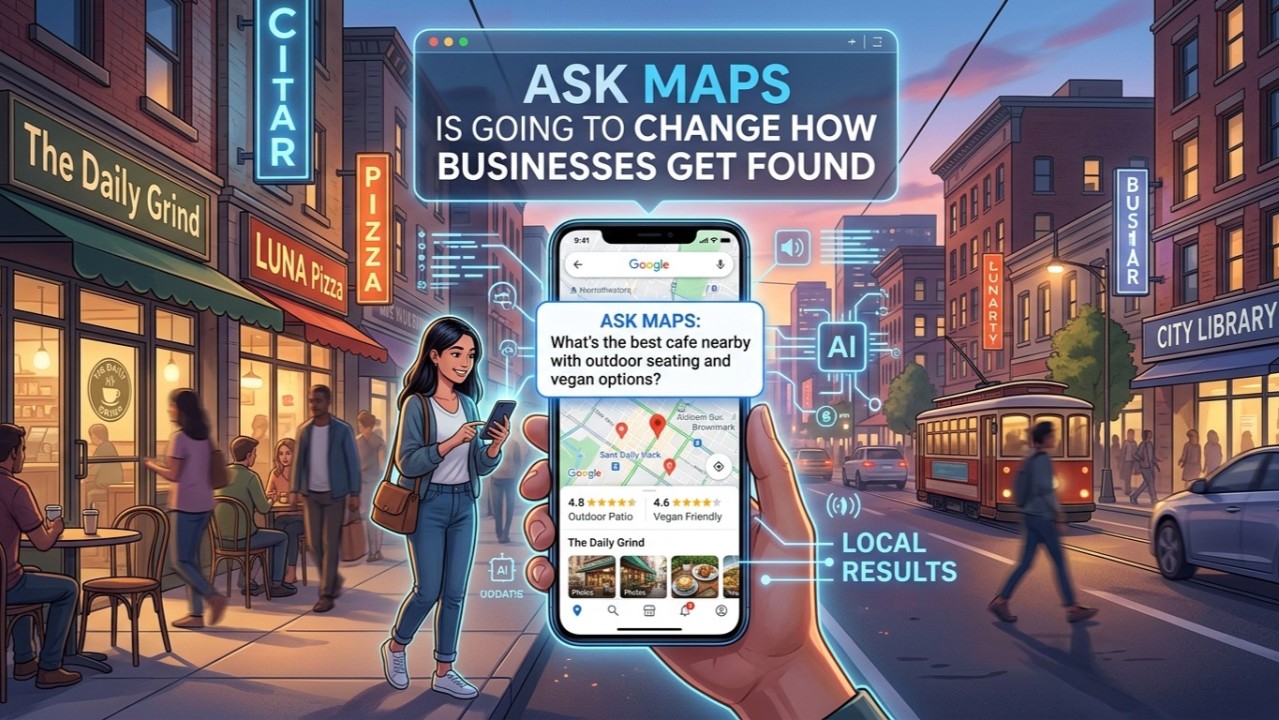
From Directory to FAQ: How Ask Maps is Changing the Rules of Local Discovery
After the biggest Google Maps update in more than a decade, Ask Maps has emerged as the feature that will redefine local search visibility. It is a Gemini-powered conversational feature that lets users ask complex, situational questions instead of typing keyword searches. Things like “where can I grab something healthy on my way to x destination” or “help me plan my travel itinerary and find sites along the way.”
Before we talk about the new features, consider where things already stand:
- Google Maps has over 2 billion active monthly users as of 2026
- 46% of all monthly Google searches have local intent, roughly 97 billion local searches per month or 3.2 billion daily
- 78% of local mobile searches result in an offline purchase within 24 hours
- One in five consumers conduct local searches directly within maps apps
Local SEO has never been so interesting but are the results of Ask Maps useful? Or is it just more AI misinformation due to old reviews, outdated websites and unoptimized listings?
Traditional Map searches vs Ask Maps
While traditional Maps search relies on established ranking factors, Ask Maps shifts the focus toward AI-driven intent and conversational context. Traditionally, you search a keyword expecting a scrollable list of 20 or more results sorted by proximity, relevance, and prominence.
Ask Maps works differently. Users provide nuanced, personalized prompts detailing exactly what they need. With voice input, those prompts can carry even more detail than most people would bother typing. Gemini returns a curated set of three to eight recommendations with narrative context pulled from reviews, business attributes, website content, third party sites your business is mentioned on, and the user’s personal Maps history. Failing to make the list likely means AI did not have enough signals to confidently recommend you, or that you simply were not the most relevant match for what the user described.
When the result set shrinks from twenty businesses to seven or eight, every slot becomes exponentially more valuable. When Google’s Gemini is the one choosing which businesses fill those slots based on AI interpretation the ranking factors of visibility change. AI decides your visibility based on your brand’s story. Content and context can be the driving force over proximity and prominence.
Social Media Posts are a Ranking Factor for Ask Maps
Google Maps actively crawls a business’s connected social media accounts to discover upcoming events, exclusive offers, and daily specials. When a user queries the “Ask” button in Maps, the AI pulls directly from these social feeds to generate conversational answers. This means users no longer have to hunt across multiple directories to see what’s happening. Google curates it all to keep the user inside its ecosystem. By strategically tailoring your social posts, you are directly feeding the Ask Maps algorithm. (For a great breakdown on this strategy, check out How to Get Your Events Featured in Google Maps).
To test this out, I asked Ask Maps, ‘What events are happening in my area this weekend?’ The idea of instantly discovering a curated mix of local activities, like a farmers market, a family-friendly outing, and live music was incredibly exciting. Instead of scouring community boards and subscribing to multiple publications just to stay in the loop, I could rely entirely on this one powerful feature.

What Google Needs to do to Improve the Ask Maps Experience
While using Ask Maps to find happy hour offers and local events is undeniably convenient, its true usefulness hinges on one critical feature; links. In the example above, I asked Ask Maps for local events happening this weekend. It generated five results, but only provided a source link for one. Because AI is prone to inaccuracies, I wouldn’t trust the unverified results without calling the venue to confirm. Without clear links, Google places the burden of fact-checking entirely on the user and it’s hard to say how many average users realize they need to verify these AI-generated recommendations.
I also felt a bit uneasy once I clicked into the GBP but no mention of the event was present. I was looking to validate the data within maps and felt the need to cross reference somewhere.
You Can’t Always Trust AI Results in Ask Maps
To test the accuracy of Ask Maps, I ran a conversational query about a local business: “Does x Jewelers in Grosse Pointe carry Rolex and Cartier watches?” Ask Maps confidently answered “yes,” but the reality was quite different.

The jeweler is no longer a Rolex retailer (though they do offer servicing) and they do not carry Cartier watches. So, where did Ask Maps get its info?
The root of the AI’s confusion is a classic technical SEO issue. The official website link Ask Maps provided pointed to an outdated, orphaned page. It had “Cartier” in the URL but contained no actual content. Because the owners never de-indexed this page, the AI crawled it, despite it no longer being linked anywhere on the live site.
Furthermore, the third-party listicles Ask Maps cited only mentioned that the jeweler carried the Rolex and Cartier brands (likely referring to jewelry), my query specifically asked for watches.

The one blog post cited did mention top watch brands inside a fact box but no content in the actual page mentioned the brands. The article was dated from 2016.

Ask Maps had absolutely no hesitation in confidently answering my question. It essentially scraped together scattered, fragmented pieces of data and presented them as absolute fact. To be fair as a user I would have no issue coming to the same conclusion stumbling on those cited sources.
Expert Deep Dive: The Future of Local Search
In this episode of the Near Media podcast, I join a panel of local SEO experts Adam Dorfman, Greg Sterling, Mike Blumenthal and Darren Shaw to discuss the real-world implications of Ask Maps, including a breakdown of the jeweler case study mentioned above.
Is Your GBP Telling the AI the Right Story?
I recently audited how Google’s AI handles the “Ask a question” feature in Google Maps for a local coffee shop. The results were a perfect case study in why your Google Business Profile (GBP) needs to be fully optimized. When a user asks a question, Google isn’t just scanning reviews or your website. It’s pulling from a wide variety of data points. In this specific audit, the AI pulled from:
- The Business Description: It quoted the owner’s goal of bringing the community together through quality coffee and pastries.
- Visual Data (Computer Vision): The AI explicitly stated, “The cafe has a display case with pastries,” because it literally “saw” the pastries in an uploaded photo.
- Attributes: It confirmed prepared foods and comfort food based on the backend attributes.

Here is where it gets interesting: this business has a dedicated catering page on their website. However, because “Catering” wasn’t selected as a category or a specific attribute in the GBP dashboard, the AI told the user: “There is not much information about catering services.”

Google’s models are expanding rapidly. They are reading your menus, identifying objects in your photos, and cross-referencing your attributes and business description to see if you’re a match for the user’s intent.

You have to ask yourself: is your GBP accurately reflecting what you actually do, or is the AI defaulting to, “It looks like there is not much information available about…
Ask Maps filters heavily based on entity signals.
To test Ask Maps’ entity interpretation, I searched for “healthy fast food” on a specific local route. The results highlighted places like Clean Eats but completely excluded giants like McDonald’s and Wendy’s. Yet, when I removed the “healthy” modifier, those big brands immediately appeared. So while they are a fast food option they aren’t “healthy”.

AI relies on entity signals. If the existing local data doesn’t support a search modifier, your brand is ignored, regardless of its national presence. This creates a massive hurdle for large chains trying to pivot. Which naturally leads to brands wanting to pay to play.
Pay to Get Recommended in Ask Maps with LSA
When reporters asked Google about ads at the Ask Maps launch briefing, the answer was exactly what you’d expect. The official line was that they are currently “focused on the user experience” and not including ads right now. They notably refused to rule them out for the future. We all know that Google is working behind the scenes to figure out monetization.
It makes perfect sense when you look at the monetization logic. People using conversational queries in Ask Maps have incredibly high intent. If someone searches, “What restaurants are featuring happy hour specials on bottles of wine,” they aren’t casually browsing; they have a higher likelihood of converting into a booking, call or click.
Google built a two-trillion-dollar business monetizing exactly that kind of intent. If Ask Maps only hands users a short list of three to eight recommendations, organic visibility is going to be brutally scarce. The second a business realizes they can’t crack that short list organically, they are going to want to pay their way in.
The fit between LSA and Ask Maps makes perfect sense. Integrating LSA into Ask Maps is the obvious next step. Ask Maps already curates its conversational recommendations from Google Business Profiles, setting the perfect stage for a sponsored placement model.
We are already seeing the groundwork for this shift. With Google’s expansion of Local Services Ads to restaurants, coffee houses, and dessert shops, the company is actively positioning its ad product to capture the high-intent hospitality queries that Ask Maps is designed to answer.
What Brands Should Be Doing Now to Optimize for Ask Maps
Ask Maps requires a complete rethinking of local SEO. It is no longer just about optimizing a Google Business Profile; it is about controlling the narrative across your entire digital footprint. Greg Sterling said it best “Your GBP becomes data fodder for Google’s AI models. You need to think about tailoring the entire GBP to customer FAQs.” To really thrive this transition, brands should take immediate action in four areas:
- Audit Technical SEO and Website Hygiene: Ask Maps does not know the difference between your active homepage and an orphaned, outdated URL. If you have dead pages, inactive pages with keywords in the URL, or outdated content, AI will scrape them and present them as absolute fact. You should de-index old pages and clean up your site architecture.
- Leverage Social Media as Local SEO: Treat your social media posts as a direct data feed for Ask Maps. Regularly post about upcoming events, current promotions, and specific offers so the AI can pull that context directly into its conversational recommendations.
- Leverage Google Posts: I have yet to find an example of Ask Maps pulling in data from Google post however, Google engineers have recently revamped how posts are featured and now display offers on branded search. As Gemini evolves, it is highly likely it will begin sourcing answers from this data. In the meantime, maintaining active posts acts as a safety net: even if the AI doesn’t provide a direct link to your event or offer, users can easily verify the details by checking your recent updates.
- Tailor Your GBP to FAQs: Treat your profile as a direct answer engine by embedding common customer questions into your description, attributes, and website content. Leaving gaps forces the AI to guess or it tells the customer there is not much information… to answer the question.
Final Thoughts: Treat Your GBP Like a Hyper-Targeted FAQ
Ask Maps is changing local search. Your Google Business Profile isn’t just a basic directory listing anymore, it’s a data fodder for Google’s AI. Getting found now means auditing your entity signals, answering real customer FAQs right in your profile, and using your social feeds to push fresh data to the algorithm.
Building that AI confidence is how you get recommended organically. But with organic map results shrinking to just a few curated answers, Google’s endgame is obvious: Local Services Ads are going to be the primary way to guarantee your placement. Clean up your data today so AI actually understands your business.


